


Guest post from Lawrence Goldstone:
When George Orwell wrote, “All animals are equal, but some are more equal than others,” he might well have been talking about American democracy.
From our founding, the government has been structured to favor certain groups, especially white men.
Restrictions on who could or could not vote was the most common means of maintaining supremacy, but drawing electoral districts to determine who could and could not be elected was also an effective strategy.
At the Constitutional Convention in 1787, delegates were aware of what in Great Britain would later be called “rotten boroughs,” once-populous districts that had lost most of their residents but were still represented in parliament. These districts generally came under the control of one or two powerful families and thus functioned as private fiefdoms. A similarly distorted electoral district in the United States could allow one or another faction to do the same.
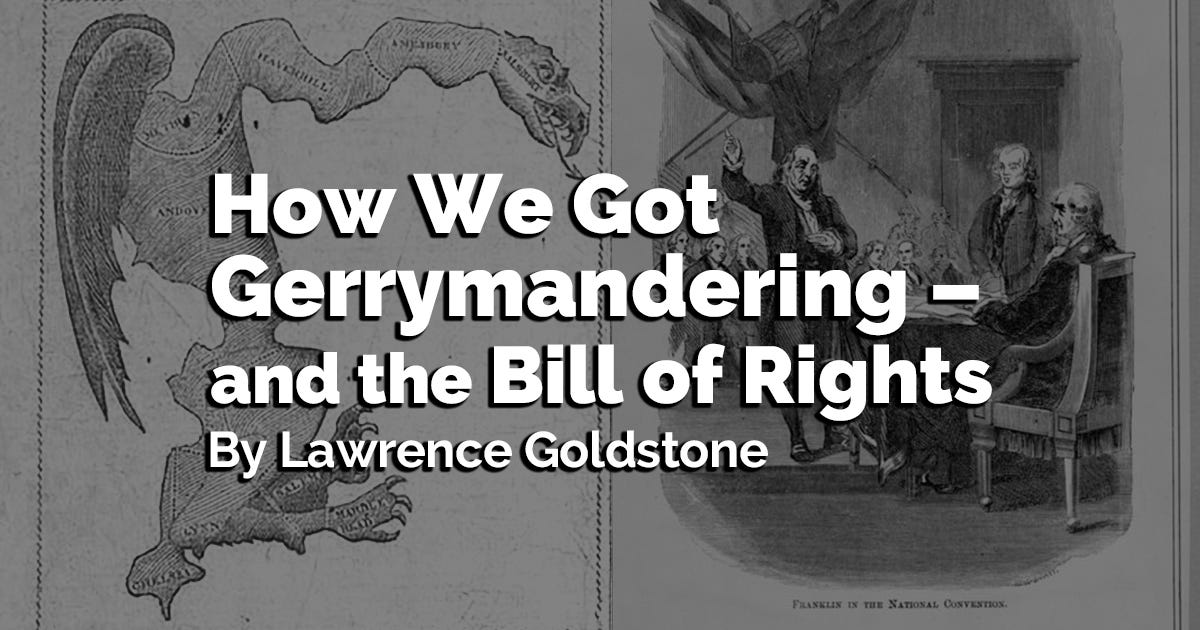
Although such districts would not be termed “gerrymandered” until 1812, after a salamander-like Massachusetts state legislative district while Elbridge Gerry was governor, a stern warning against allowing states to draw electoral boundaries was voiced during the Constitutional debates by James Madison. “Legislatures of the States ought not to have the uncontrolled right of regulating the times, places & manner of holding elections,” Madison told the delegates. “It is impossible to foresee all the abuses that might be made of this discretionary power.”
But any attempt to impose national standards on what had been strictly a state prerogative would be an impediment to ratification, which was hardly a sure thing to begin with. And so, the Convention ignored Madison and left electoral districts to the discretion of the states.
And, ironically, who almost became the first victim of the gerrymander, decades before the phrase was coined? Madison himself.
When the Virginia ratifying convention met in June 1788, sentiment was strong against ceding power to a national government that would, at least at first, be controlled by northern states. Leading the opposition was the brilliant and ruthless Patrick Henry, “the spellbinder from Prince Edward County,” considered the finest trial lawyer in the United States. Leading the pro-Constitution forces was Madison.
Henry dominated the Convention, speaking for as long as seven hours at a stretch. Madison spoke chiefly in rebuttal, oftentimes in a voice so low that he could not be heard throughout the meeting hall.
But Madison was brilliant. He deflated Henry’s bluster, exposing his faulty logic, inaccurate reading of history, and misconstruction of the language of the document. After Henry’s last-ditch effort to attach a string of conditional amendments was defeated, Virginia, the most populous and important state, voted narrowly to ratify the Constitution.
Henry vowed revenge. When the Virginia General Assembly met in October 1788 to choose the state’s two new senators and set the conditions for the election of members of the House of Representatives, Henry successfully schemed to prevent them from appointing Madison to the Senate. The seats went instead to his allies William Grayson and Richard Henry Lee.
Henry then set his sights on keeping Madison out of the House. He prevailed on state officials to draw district lines skewing heavily to Madison’s opponents, and then persuaded James Monroe, a young and popular war hero, to seek the seat. If Monroe won, Madison would be shut out of the new government entirely,
George Washington, who was none too fond of Henry either, sent an urgent message to Madison, who was sitting in the last Confederation Congress in New York. Madison rode home through freezing weather, and was then forced to campaign through cold and snow while ill from the journey.
A key issue was Madison’s resistance to amending the new Constitution with a delineation of individual and state rights. The ever-practical Madison quickly pivoted and became a champion of the very amendments he had opposed.
It worked. Madison bested Henry for a second time, beating Monroe handily. Eventually, he would draft twelve amendments and submit them to Congress, ten of which would be adopted. And so, the United States got the Bill of Rights.
While Madison may have won the battle, however, the nation lost the war.
The problem we have now is that the Supreme Court has ignored Madison’s warnings and allowed any distortion of electoral districts it considers “political” to be constitutionally acceptable, even if effectively disenfranchising every Black voter in Louisiana and turning the equal protection clause of the 14th Amendment into hollow verbiage.
Instead, with the Court’s enthusiastic assistance, previously established guarantees are being washed away quicker than a sandcastle at high tide by a panel of justices who seem to think white supremacy and equal opportunity are synonymous.
With state governments allowed to run amok, redistricting can now be used even more aggressively as a weapon to silence Black and Brown Americans, the last thing a nation as divided as ours is now can afford.
Lawrence Goldstone’s book On Account of Race: The Supreme Court, White Supremacy, and the Ravaging of African American Voting Rights won the 2021 Lillian Smith Book Award. Follow him on Substack here.
Sorry didn't think we were talking about Roman History but U.S. I point out that Adam Smith's classic on Capitalism was published in 1775 - year sound familiar? I think that is where the issue of "Why Slavery" in this country continued past the Revolution. You can stick with Schumpeter if you want and I will go with Marx. Read "On Money" and you will see it is the USA today. The three issues that curse the United States in every way today (and cause racism) Alienation, monopoly Capitalism and income inequality. Playing the race card will never solve racial inequality by using another race card. If you can pull up this morning's Seattle Times and read the funding fraud that has gone on for the past years - comes right out of Lowi's book. If the Democrats expect to win in 2026 they better remember what Carvelle told Clinton in 1992 - "It's the economy stupid."
Instead of attacking based on race (and losing) why don't you study some political theory and economic history. i.e. Slavery is just a component of Capitalism. Cheap labor. The system is built in favor of Capitalism. All the laws regarding Unions are against the workers (Taft-Hartley 1947). So instead of attacking Capitalism (now as Lowi writes in 'The End of Liberalism' - not an economic system but American culture) you attack "white men" - race instead of economics - keep it up and keep losing elections to Fascists. Racism, greed, and violence is just part of Capitalism.